Choosing the right evening
Dance show or dervish ceremony?
How Rhythm of the Dance differs from a whirling-dervish (sema) ceremony in the same Istanbul hall, which one suits you, and what each asks of you.
Reserve a seat in Sirkeci ↗Quick answer
Rhythm of the Dance is a staged, modern folk-dance show with costumes, live music and video projection. A whirling-dervish ceremony is the sema, a ritual of the Mevlevi Sufi order that UNESCO lists as intangible cultural heritage. Both are hosted at the Hodjapasha Culture Center in Istanbul, but they are separate evenings and separate bookings. Book Rhythm of the Dance for dance and spectacle, and the ceremony only if the ritual is what you want to see.
The short answer
If you want to watch dancers in costume perform regional folk dances to live music, with modern choreography and projections, book Rhythm of the Dance. If you want to see the Mevlevi sema, the whirling ceremony of the Sufi order founded around Rumi's followers, that is a different evening. The two share a building, which is why travellers mix them up, and the ticket this site links to is for the dance show. Neither is better; they answer different questions. Both evenings take place in a restored Ottoman bath, so the setting alone does not tell you which one you are at. This guide sets the two side by side and helps you pick the one that matches what you came to see.
What Rhythm of the Dance is
The ticket describes a lively performance of traditional dances, folk music, colourful costumes and video projections. Professional dancers perform Turkish folklore dances from different regions of Anatolia, blended with modern choreography and live music. The show runs for 65 minutes. It is entertainment in the plainest sense, and none the worse for that: a staged programme designed to be seen by visitors, with a beginning, an end and no expectation that you know anything beforehand. Some travellers say the modern character should be spelled out, and this guide spells it out: the choreography is contemporary, the staging uses projection, and the programme is built around dance, not worship. The programme booklet that comes with the ticket is the place to look for the pieces on your date.
What the sema is
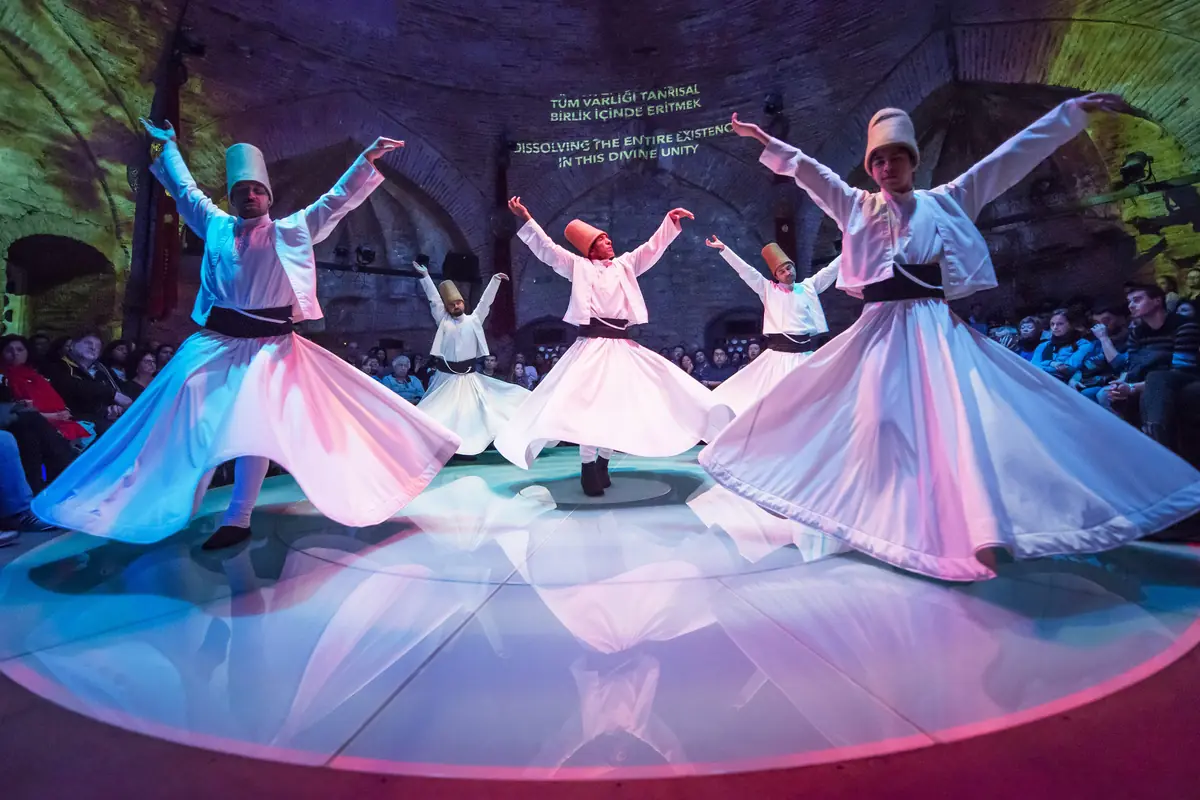
UNESCO describes the Mevlevi Sema ceremony as a ritual of the Mevleviye, a Sufi order founded in 1273 in Konya, accompanied by a musical repertoire called the ayin. Dancers turn on their left feet. Wikipedia calls the sema a form of worship in which participants, called semazens, whirl during remembrance of God, and describes the whirling as symbolic and performed in a counter-clockwise circle. The whirling in a sema is not choreography for an audience; it is a spiritual practice, and the clothing and the order of the ceremony carry meaning.
The order behind the ceremony
Wikipedia says the Mevlevi order, also called the Mawlawiyya, began in Konya among followers of Rumi, the 13th-century Persian poet and mystic. UNESCO says the order gradually spread throughout the Ottoman Empire, and that dancers historically completed 1,001 days of training in Mevlevi houses, learning ethics, prayer, religious music, poetry and dance. It adds that all the Mevlevi houses were closed in 1925, that performances later resumed in public, and that a few private groups now work to revive its spiritual side. That history is why a sema is not simply another dance programme.
Why the two get mixed up
Both are staged at the Hodjapasha Culture Center, and the centre presents them side by side on its own website, one labelled Whirling Dervishes and one Rhythm of the Dance. The Rhythm of the Dance ticket also mentions a Dervish exhibition in the foyer, so a visitor can walk past dervish material on the way to a folk-dance show. Add the word Istanbul and the word hamam, and it is easy to arrive with the wrong expectation. The result is a building where two different traditions share a door. Some travellers say so in their reviews, which is the reason this guide exists. The remedy is simple: read the title of the ticket you are booking, and check that it says Rhythm of the Dance.
Mood and manner
A folk-dance show invites applause, a camera-friendly spectacle and a lively mood. A sema is traditionally a ritual, and Wikipedia notes that in its devotional setting whirling is worship, not entertainment. Turkey outlawed Sufism in September 1925, Wikipedia says, and sema performances are now presented as cultural events rather than worship. UNESCO adds that many performances have been shortened and simplified for tourist audiences. Whatever the format, a ceremony asks for a quieter, more respectful attitude than a dance show, and you should follow the hall's guidance on the evening you choose, especially about photographs and noise, which this guide cannot predict for your date.
Read next: Hodjapasha dance show, explained
What you see on stage
In a Mevlevi sema, Wikipedia says, the whirling dancers wear a white skirt that stands for the ego's shroud and a felt cap that stands for a tombstone, and they remove a black cloak before turning. UNESCO says the whirling follows a recommended fast. In Rhythm of the Dance, the ticket promises colourful costumes, together with video projections that change the look of the hall. One evening is built on symbolism and repetition. The other is built on variety, contrast and a sense of a whole country in an hour. The contrast is visual as much as musical. If you are travelling with someone who is curious about religion and someone who wants a lively night, you may want to book on two different evenings.
Music and rhythm
The sema is accompanied by the ayin repertoire, which UNESCO says is performed by singers and instrumentalists. Rhythm of the Dance uses folk music played live, and Wikipedia says the davul and zurna accompany many Turkish folk dances while the bağlama and kemençe appear in particular regions. The ticket does not list the instruments, so treat that as general background rather than a programme. Folk dances are driven by rhythm, often in meters such as 9/8, which Wikipedia calls especially characteristic of Turkish folk music. Wikipedia adds that the zurna's volume is constant, so drums usually provide the beat. The guide to the instruments of Anatolian dance explains the sounds in more detail.
Which one suits you
Choose by what you came to see, not by which one has the better review score. Both are popular, and a rating mostly tells you whether people got what they expected. Use the list below to decide, then book the matching ticket. Ask the people you are travelling with as well; a group that disagrees about the ceremony is better off splitting the two evenings. If you are still undecided, ask yourself one question: do you want to watch a performance, or witness a ritual? The first answer points to Rhythm of the Dance, and the second to the sema, which is a separate booking and not sold on this site.
- Want costumes, regional dances and live music: Rhythm of the Dance
- Want a ritual, quiet and symbolic: the sema, booked separately
- Travelling with teenagers who like spectacle: the dance show
- Interested in Sufi history: the ceremony, plus a museum visit
If you want both
You can book both on different evenings, because each has its own booking and its own calendar. Their start times and dates are set separately, so check each calendar rather than assuming a pattern, and do not assume that a date free on one is free on the other. If you only have one evening, decide by the list above and keep the other for a later trip. This site links only to the dance show; the ceremony has its own booking page elsewhere, and you can book it there if you want it. Whichever you choose, read the title and the description on the booking page, so you know which of the two you are buying. Check the date and the title on each calendar before you pay.
Who this isn't for
Readers who have already settled on the ceremony will find little here: you will learn only how the two differ, not how the sema unfolds. Nor is it for visitors needing wheelchair access, which the Rhythm of the Dance booking page rules out. And it is not a religious guide: for a closer understanding of the Mevlevi order, read UNESCO's description and the other sources listed below. The aim here is narrower, to stop you arriving at the wrong evening, and to make the right one easier to choose. It is also no substitute for the sources: UNESCO's entry and the Wikipedia articles listed below say far more about the ceremony than a ticket guide can.
Frequently asked questions
Is Rhythm of the Dance a religious ceremony?
No. It is a staged folk-dance show with modern choreography. The sema is the religious ritual, and it is a separate booking.
Do both take place in the same building?
Yes. The Hodjapasha Culture Center presents both a whirling-dervish ceremony and Rhythm of the Dance, as separate shows.
What does UNESCO say about the sema?
UNESCO inscribed the Mevlevi Sema ceremony in 2008 as intangible cultural heritage of humanity.
How long is Rhythm of the Dance?
The show lasts 65 minutes.
Which one should a first-time visitor book?
Book the one that matches what you want to see. Choose Rhythm of the Dance for dance, costume and music, and the ceremony only if you want the ritual.
Sources